physiology and anatomy
anatomy
science
that studies the form and composition of the body’s structures
gross anatomy
study
of the larger structures of the body, typically with the unaided eye; also
referred to macroscopic anatomy
homeostasis
steady
state of body systems that living organisms maintain
microscopic anatomy
study
of very small structures of the body using magnification
physiology
science
that studies the chemistry, biochemistry, and physics of the body’s functions
regional anatomy
study
of the structures that contribute to specific body regions
systemic anatomy
study
of the structures that contribute to specific body systems
Human
anatomy is the scientific study of the body’s structures. Some of these
structures are very small and can only be observed and analysed with the
assistance of a microscope. Other larger structures can readily be seen,
manipulated, measured, and weighed. The word “anatomy” comes from a Greek root
that means “to cut apart.” Human anatomy was first studied by observing the
exterior of the body and observing the wounds of soldiers and other injuries.
Later, physicians could dissect bodies of the dead to augment their knowledge.
When a body is dissected, its structures are cut apart in order to observe
their physical attributes and their relationships to one another. Dissection is
still used in medical schools, anatomy courses, and in pathology labs. In order
to observe structures in living people, however, several imaging techniques
have been developed. These techniques allow clinicians to visualize structures
inside the living body such as a cancerous tumor or a fractured bone.
Like
most scientific disciplines, anatomy has areas of specialization. Gross anatomy
is the study of the larger structures of the body, those visible without the
aid of magnification. Macro- means “large,” thus, gross anatomy is also
referred to as macroscopic anatomy. In contrast, micro- means “small,” and
microscopic anatomy is the study of structures that can be observed only with
the use of a microscope or other magnification devices. Microscopic anatomy
includes cytology, the study of cells and histology, the study of tissues. As
the technology of microscopes has advanced, anatomists have been able to
observe smaller and smaller structures of the body, from slices of large
structures like the heart, to the three-dimensional structures of large
molecules in the body.
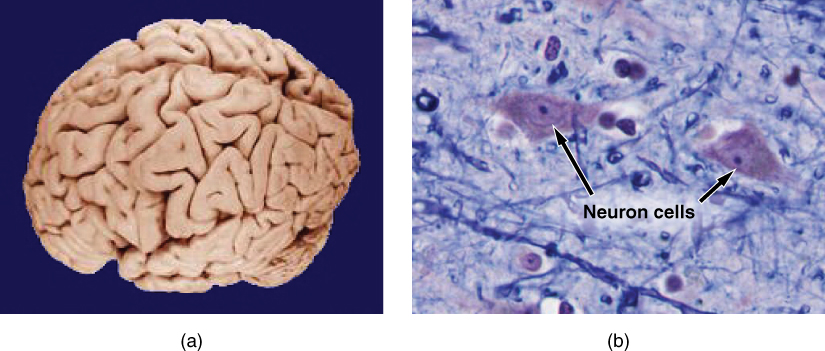
Gross
and Microscopic Anatomy. (a) Gross
anatomy considers large structures such as the brain. (b) Microscopic anatomy can deal with the same structures, though
at a different scale. This is a micrograph of nerve cells from the brain. LM × 1600.
Anatomists
take two general approaches to the study of the body’s structures: regional and
systemic. Regional anatomy is the study of the interrelationships of all the
structures in a specific body region, such as the abdomen. Studying regional
anatomy helps us appreciate the interrelationships of body structures, such as
how muscles, nerves, blood vessels, and other structures work together to serve
a body region. In contrast, systemic anatomy is the study of the structures
that make up a discrete body system—that is, a group of structures that work
together to perform a unique body function. For example, a systemic anatomical
study of the muscular system would consider all the skeletal muscles of the body.
Whereas
anatomy is about structure, physiology is about function. Human physiology is
the scientific study of the chemistry and physics of the structures of the body
and the ways in which they work together to support the functions of life. Much
of the study of physiology centres on the body’s tendency toward homeostasis.
Homeostasis is the state of steady internal conditions maintained by living
things. The study of physiology certainly includes observation, both with the
naked eye and with microscopes, as well as manipulations and measurements.
However, current advances in physiology usually depend on carefully designed
laboratory experiments that reveal the functions of the many structures and
chemical compounds that make up the human body.
Like
anatomists, physiologists typically specialize in a branch of physiology. For
example, neurophysiology is the study of the brain, spinal cord, and nerves and
how they work together to perform functions as complex and diverse as vision,
movement, and thinking. Physiologists may work from the organ level (exploring,
for example, what different parts of the brain do) to the molecular level (such
as exploring how an electrochemical signal travels along nerves).
Form
is closely related to function in all living things. For example, the thin flap
of your eyelid can snap down to clear away dust particles and almost
instantaneously slide back up to allow you to see again. At the microscopic
level, the arrangement and function of the nerves and muscles that serve the
eyelid allow for its quick action and retreat. At a smaller level of analysis,
the function of these nerves and muscles likewise relies on the interactions of
specific molecules and ions. Even the three-dimensional structure of certain
molecules is essential to their function.
Your
study of anatomy and physiology will make more sense if you continually relate
the form of the structures you are studying to their function. In fact, it can
be somewhat frustrating to attempt to study anatomy without an understanding of
the physiology that a body structure supports. Imagine, for example, trying to
appreciate the unique arrangement of the bones of the human hand if you had no
conception of the function of the hand. Fortunately, your understanding of how the
human hand manipulates tools—from pens to cell phones—helps you appreciate the
unique alignment of the thumb in opposition to the four fingers, making your
hand a structure that allows you to pinch and grasp objects and type text
messages.
Critical thinking
An understanding of anatomy and physiology is essential for any
career in the health professions. It can also help you make choices that
promote your health, respond appropriately to signs of illness, make sense of
health-related news, and help you in your roles as a parent, spouse, partner,
friend, colleague, and caregiver.
A student would more readily appreciate the structures revealed in
the dissection. Even though the student has not yet studied the workings of the
heart and blood vessels in her class, she has experienced her heart beating
every moment of her life, has probably felt her pulse, and likely has at least
a basic understanding of the role of the heart in pumping blood throughout her
body. This understanding of the heart’s function (physiology) would support her
study of the heart’s form (anatomy)

Comments
Post a Comment