how a camera works
A digital single-lens reflex camera, or DSLR, is a combination of
two different camera technologies. First, the single-lens reflex technology
determines how the shutter operates to allow light through the lens and onto
the sensor. Second, the digital aspect of the camera means that the camera uses
a digital sensor to capture the image instead of a piece of film.
Like all cameras, a DSLR works by manipulating light. When light
bounces off the subject and makes its way to the observer, where the camera is
located, if the light passes through a small enough opening it can create an
image on the other side of the opening. By using a lens, positioned in front of
the opening, the camera operator can bring that image into focus at a given
distance behind the opening, which is where the DSLR's digital image censor is
located.

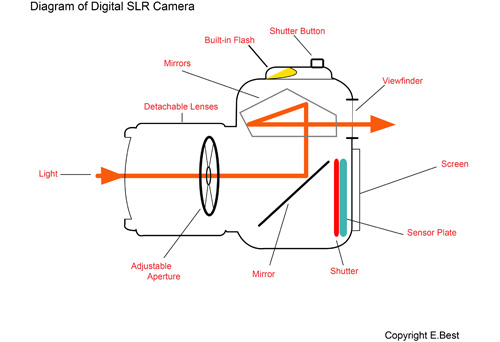
The SLR aspect of the DSLR solves an old camera problem where the
photographer's view of the subject was not the same as the camera's. When the
shutter is closed, no light is getting through to the sensor, so the operator
has to view the subject through a viewfinder, which may have a slightly
different view of the subject. In an SLR camera, a mirror sits in front of the
sensor or film, and light passing through the lens is reflected up into a prism
and out into the viewfinder. When you press the shutter button, the mirror
flips up out of the way and the two curtains that make up the shutter slide out
of the way, allowing light to pass through and strike the sensor, creating the
image.
The digital sensor that captures the image separates DSLRs from
old SLR film-based cameras. The sensor is made up of millions of photo sites,
which are also often called pixels, that are sensitive to light. When light
strikes the sensor the individual photons are directed into the photo sites
where they are absorbed. The material in the photo site then releases an
electron, creating an electrical charge. Once the image capturing is done, the
power of the resulting charge from each photo site is relative to the number of
photons that struck the sensor, and thus signifies the intensity of the light
in that area of the image. This information is then fed into a processor, which
creates the image that you see on the display. The digital sensor's photo sites
are arranged to capture red, green and blue light, as more than 16 million
visible colours can be recreated using a mixture of these three colours.
The digital aspect of DLSRs is one of their largest benefits, as
you don't have to deal with physical film. This makes storing, moving and
copying images so much easier. It also means that your images are stored on a
memory card, which can be large enough to allow you to capture and store
thousands of images. The mechanics of DSLRs also make them ideal when shooting
speed is important. You can bring a DSLR into focus and snap the shot in a
fraction of the time it would take a standard digital camera to do the same
process. Because DSLRs require the use of a physical lens, they also allow you
to change lenses to suit your needs.
The physics behind a camera
Cameras use physics in ways that run the gamut from mundane to
esoteric.
The mundane: DSLRs are loaded with straightforward levers, gears
and wheels, mostly to move the mirror and the shutter. The mechanics even
extend, in some cases, to pneumatics in the vibration dampers on both the
mirror and shutter mechanisms.
Less mundane, but still in the realm of understandable: Every
camera uses the physics of optics in two mechanisms, the lens and the aperture.
The lens refracts light selectively, depending on how it falls on each element
that makes up the lens to bend it to a focal point somewhere near the plane of
the sensor or film. Refraction properties in the materials of the lens (usually
referred to generically as "glass" regardless of their relationship
to true glass) are finely calibrated and can be formed to high precision, all
based on physics. The aperture is an adjustable opening calibrated in a way
where each step in its scale allows half as much or twice as much as the
adjacent steps. The aperture controls two attributes of the light entering the
camera. First, it controls the intensity as it opens wider or closes smaller.
At the same time, the aperture functions the same way a pinhole functions in a
camera obscura, restricting the light entering the camera in such a way that,
even without a lens, an image would be formed. With a lens, the camera obscura
effect blocks unfocused light from obscuring details at the focal plane, increasing
the depth of the field of usable focus.
Far more esoteric: Capturing light and storing information. In
film photography, minute particles made up of specially sensitize atoms are
distributed within a gelatine substrate coating a plastic backing. When light
strikes these atoms, they begin to change, not to visible images, but to latent
images. The more exposure to light, the more atoms are changed. The change
itself is what's so esoteric because the photons interacting with the atoms are
left in a state primed to be chemically changed if subjected to the proper
chemical bath. Digital photography isn't any less exotic when it captures an
image on a sensor. Each pixel - picture element - captured in a digital image
starts out on the sensor in millions of sites designed to detect not merely the
presence of light, but it's colour and intensity, determining the relative
number of photons striking all the millions of sites across the sensor. All
these data points are captured at the time of exposure, organized into a data
file and then stored in a memory device that, in many digital cameras, uses
quantum effects in its storage of that data.
Comments
Post a Comment